K-Beauty and J-Beauty without the fluff: why emolliency is back as engineering (and why short-INCI ESSENTIKA — SQA fit naturally)
Research by
Director of Operations
Published
12 /01/2026
Category
Trends
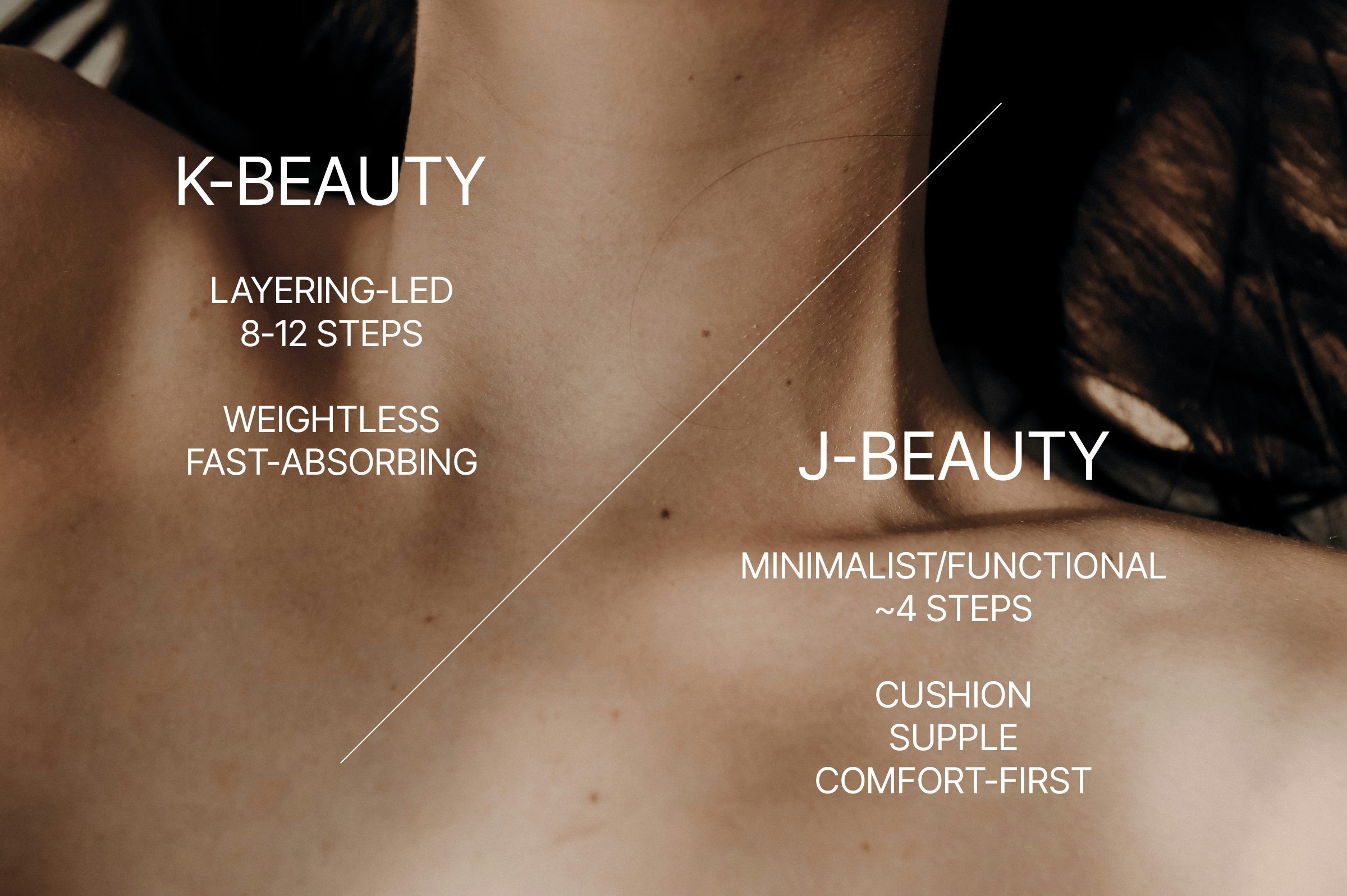
K-Beauty and J-Beauty have reshaped the market, yes, but not because of empty “trends”. They did it by focusing on what people actually buy and remember: textures that perform, don’t fatigue the user, integrate into real routines, and feel the same today and six months from now. K-Beauty has mainstreamed lightweight, breathable formats built for layering and a “barely-there” sensorial profile that never fights the next step in the routine. J-Beauty has maintained a quieter discipline: functional minimalism, refined feel, and consistency over time.
That’s the cultural headline. The technical takeaway is sharper: both schools force formulators to treat the oil phase as a system, not “just an oil”.
What’s really underneath K-Beauty (when you look at it like R&D)
Fast spread, but not an instant vanish (controlled spreading).
Low initial friction (slip) with a clean, non-draggy dry-down.
Layering compatibility without sensorial conflict (reduced pilling, lighter films).
K-Beauty isn’t only about creams. It pushes format innovation - cushions, sticks, mists, jellies, pads - which forces precision in lubricity and film behaviour. Translation: if the oil phase isn’t designed properly, you either don’t get there, or you get there with something “fine” that can’t compete with current benchmarks.
J-Beauty, when executed with discipline, does something different: it reduces variables without losing perceived quality. Fewer steps, less noise, more coherence. That implies:
Textures that don’t saturate: fast absorption, minimal greasy residue.
Clean emolliency designed for daily repetition.
Products that behave well inside a broader system.
In J-Beauty, “minimalism” is not short INCI as a slogan. It’s elegant design with fewer failure points.
The scientific bridge: real “skinimalism” and fewer-ingredient design
Simplification isn’t only marketing language. It’s also technical logic: more components mean more interactions, more instability risk, more compatibility issues, and more batch variability.
Short-INCI systems matter when they do two things:
They remain modular (you can steer the finish).
They remain industrially robust (repeatable, stable, organoleptically controlled).
That’s where intermediate solutions become genuinely useful.
ESSENTIKA — SQA Blends: short INCI, with intent.
ESSENTIKA —SQA by Naturol is a series of blends designed as B2B intermediate lipid solutions: building blocks for labs and OEM/ODMs to reach sensorial targets from the oil phase, with a coherent minimalist architecture. They are not finished consumer cosmetics, not retail-ready formulas, and not positioned to support clinical claims. Final performance depends on the complete system (water phase, emulsifiers, process, packaging, and storage).
The logic is straightforward and defensible:
A consistent emollient baseline (olive-origin squalane).
An oil-phase antioxidant reserve (Tocopherol, gamma/delta enriched in our approach).
A co-emollient that meaningfully shifts the finish.
This is not poetry. It is polarity balance, perceived volatility, friction behaviour, and film design.
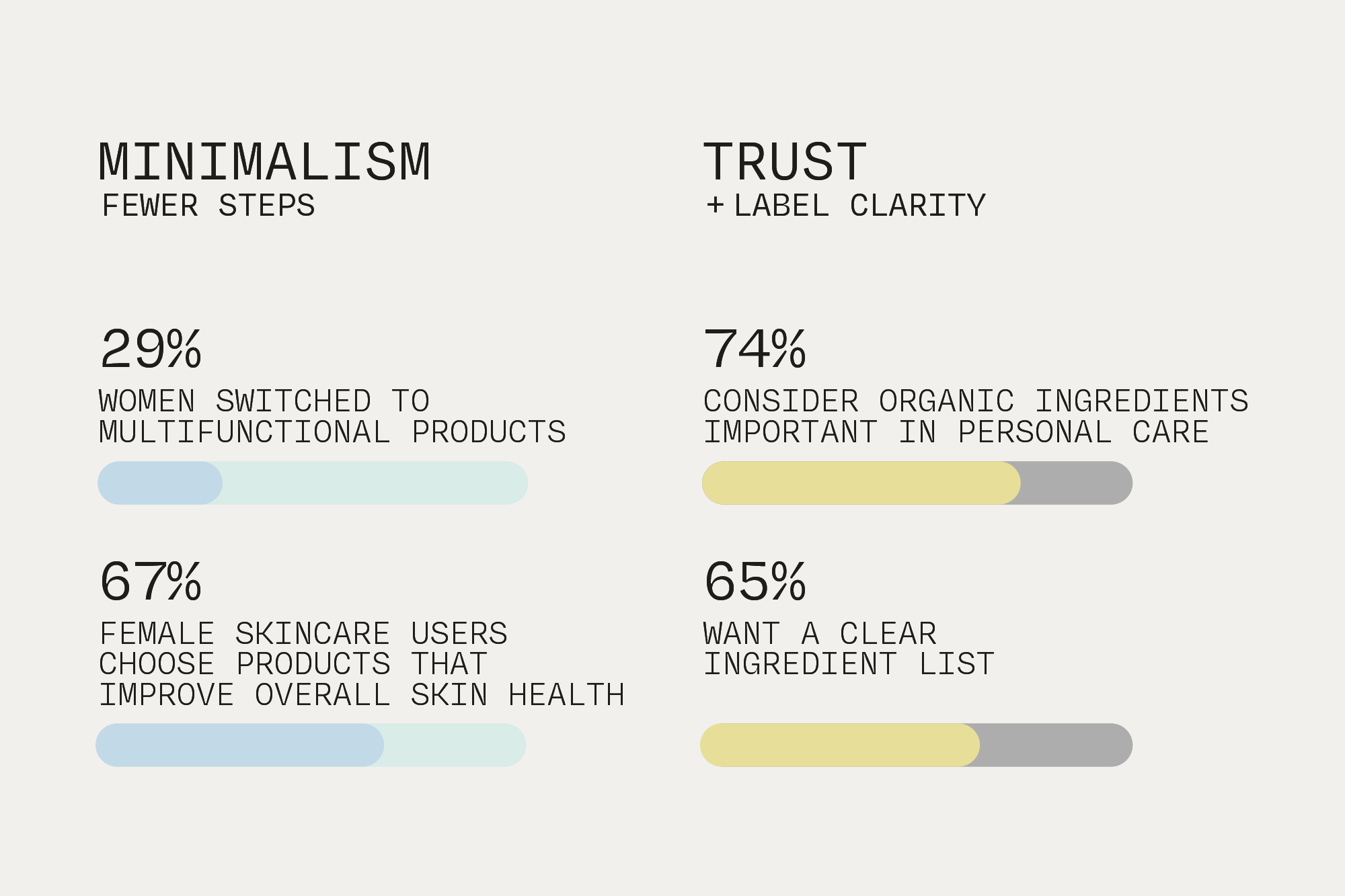
Recent consumer research highlights two converging forces shaping formulation decisions: routines are simplifying, and trust is increasingly tied to label clarity. Mintel (updated Oct 30, 2025) reports a shift toward multifunctional products and “overall skin health” benefits, while NSF’s 2025 survey (1,000 Americans; commissioned 2024) shows strong demand for organic cues and clearer ingredient lists. Together, these signals reinforce why modern B2B formulation choices, especially in the oil phase, must be data-led: fewer steps, fewer ingredients, and cleaner, more intelligible architectures are now part of performance.
Concrete use cases: where they fit in K and in J (without talking “finished products”) Here are practical formulation-style examples, framed as “how a formulator would use it”, not “what it claims”.
K-Beauty: lightweight, hybrid textures with precision dry-down
Ultra-dry touch and fast absorption in gel-creams, fluids or milky textures: ESS DRY — (Squalane + Coco-Caprylate/Caprate + Tocopherol) as a dry-touch module within the oil phase.
Silky slip for primers, bases and anhydrous color (supporting pigment wetting and glide): ESS SILK — (Squalane + Isoamyl Laurate + Tocopherol) as a satin “silk-glide” tool.
Controlled radiance (not greasy), fine film and cushion in lightweight balms or sensorial emulsions: ESS GLOW — (Squalane + Meadowfoam Seed Oil + Tocopherol) to build uniform, elegant shine without heaviness.
Minimal baseline for low-ingredient systems (anhydrous or oil phases of emulsions): ESS BASIK — (Squalane + Tocopherol) as a clean, repeatable sensorial foundation.
Calm” concepts with soft sensoriality (without overbuilding the oil film): ESS CALM — (Squalane + Bisabolol + Tocopherol) for sensitive-oriented briefs, always integrated into a full system.
Olive-heritage positioning with satin-to-dry tuning and good latitude for lipophilic actives: ESS OLIVE — (Squalane + Ethyl Olivate + Triheptanoin + Tocopherol) as a slip/absorption tuning module.
What makes this approach genuinely different: “stop selling adjectives, sell method” If you want to be original in this space, the move is not to repeat “glass skin”, “glow” or “minimal routine”. The move is to talk about what most content avoids:
How friction is engineered (slip/drag) and why it matters.
How spreading and pay-off are controlled to reduce residue, pilling, and heaviness.
How oxidative and organoleptic stability of the oil phase is documented so texture doesn’t drift over time.
That is science applied to feel. And in Korean and Japanese benchmarks, texture isn’t decoration. It’s a standard.
References Jing Daily.(2025). Jing Daily.South Korea ranked No.2 cosmetics exporter (behind France): p. 1 International Trade Council. (July 2, 2025). South Korea Becomes Global Trade Leader in Cosmetics, Surpasses U.S. in Exports - The International Trade Council. South Korea ranked No.2 cosmetics exporter (behind France): p. 2 Global Cosmetics News. (2025). South Korea Surpasses US in Cosmetics Exports, Now Second Only to France - Global Cosmetics News. South Korea ranked No.2 cosmetics exporter (behind France): pp. 1–2 Personal Care Insights. (2025). US surpasses China as K-beauty’s top market amid record-breaking exports. See source PDF for details (typically p. 1). CHOSUNBIZ. (2025). K-beauty exports hit record $8.52B through Q3 as US overtakes China and Japan rises - CHOSUNBIZ. See source PDF for details (typically p. 1). KED Global. (2025). K-beauty exports surge in Q3, heading for a full-year record; destinations diversified to 205 nations - KED Global. See source PDF for details (typically p. 1). The Business Research Company. (2026). K-Beauty Products Global Market Report 2025. See source PDF for details (typically p. 1). Fundamental Business Insights. (2026). J-Beauty Products Market Size. See source PDF for details (typically p. 1). Fortune Business Insights. (December 22, 2025). Japan Cosmetics Market Size, Share _ Growth Report [2032]. See source PDF for details (typically p. 1). Mintel (Spotlight), Trends Shaping the Future of the Skincare Industry (actualizado Oct 30, 2025). NSF (survey of 1,000 Americans commissioned in 2024; publicado Mar 6, 2025).
Note: This article describes B2B intermediate lipid solutions for formulators. ESS Blends are not finished consumer cosmetics and are not positioned to support clinical claims. Final performance depends on the complete formulation system (water phase, emulsifiers, process, packaging, and storage conditions).